Localization vs Internationalization: The Blueprint for Going Global Without Breaking Your Code
Think of your software application as a corporate representative you are sending overseas to close a massive deal. You might dress them in a sharp suit and hand them a dictionary so they can translate “Hello” and “Buy Now” into the local language.
But imagine if that representative walked into a boardroom in Tokyo and refused to bow. Imagine they insisted on paying for lunch in US Dollars while in Berlin or wrote the contract deadline in a date format that made the client think the project was already three months late.
It wouldn’t matter how perfect their grammar was. The deal would stall and possibly die.
This is the “rude tourist” problem that plagues software development. Companies often treat global expansion as a surface-level linguistic challenge rather than a deep structural one. Your software might “speak” French, but if its underlying code still “thinks” like an American, for example—assuming everyone uses 12-hour clocks and sorts alphabets the same way—you aren’t just confusing your users; you’re alienating them.
This is exactly where the confusion between localization vs internationalization leads to expensive, time-consuming rework. While these terms are often used interchangeably in boardrooms and marketing meetings, they represent two fundamentally different processes in the lifecycle of a global product.
If you are looking to expand your business borders, understanding the distinction between internationalization (i18n) and localization (l10n) is less about semantics and more about survival. Let’s dismantle the jargon together and look at how to build a product that truly belongs everywhere.
Table of Contents
The Core Concepts: i18n vs l10n Explained
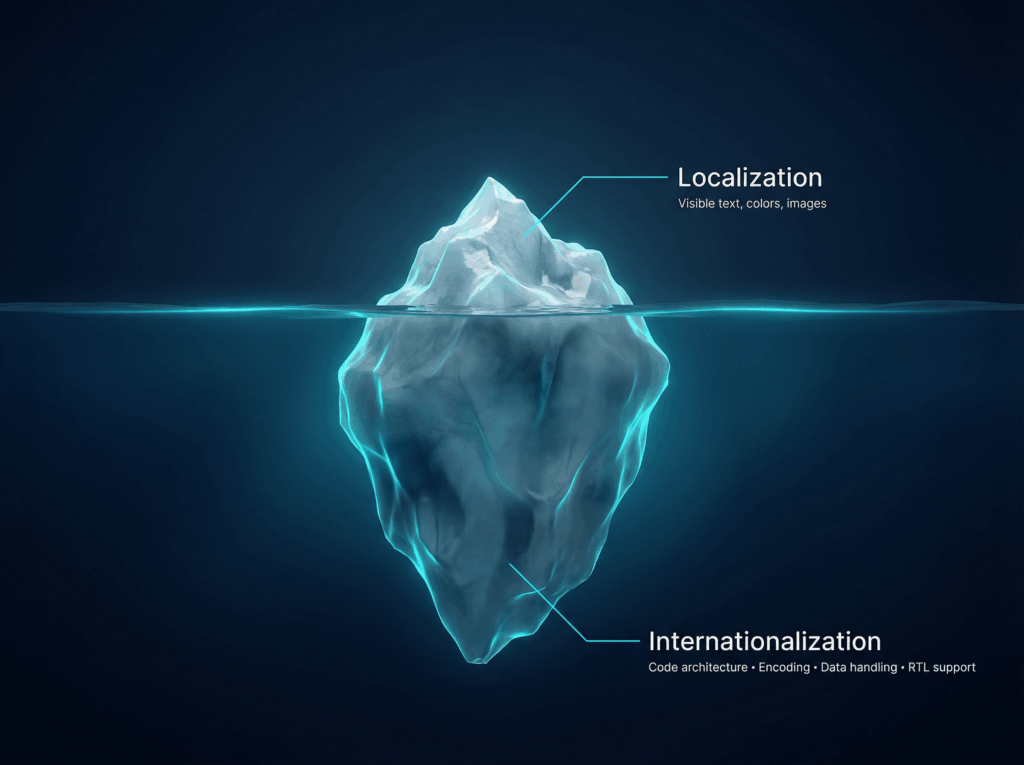
Before we dive into the technical differences, we need to clear up the abbreviations that often confuse newcomers to the industry.
Internationalization is often shortened to i18n, because there are 18 letters between the first ‘i’ and the last ‘n’. Localization is shortened to l10n for the same reason—10 letters between ‘l’ and ‘n’.
These numeronyms act as shorthand for software developers and localization professionals, but they also hint at the relationship between the two. One is the framework; the other is the finish.
What is Internationalization (i18n)?
Internationalization is the process of designing and developing a software application so that it can be adapted to various languages and regions without engineering changes.
Think of i18n as building a house. You are installing the electrical wiring, the plumbing, and the structural support. You haven’t decided on the wallpaper or the furniture yet. You are simply ensuring that the house has standard outlets that can support different appliances, or that the walls are neutral enough to accept any color of paint later.
In software terms, an internationalized product is “locale neutral.” It doesn’t assume English is the only language, or that everyone reads left-to-right. It separates the source code from the content.
What is Localization (l10n)?
If internationalization is building the house, localization is the process of adapting that house to make it feel like a home for a specific family living in a specific city.
Localization involves taking that neutral, internationalized product and tailoring it to a specific language and culture. This includes translating text, certainly, but it goes much deeper. It involves changing colors that might have negative connotations in target markets, formatting currencies, adhering to local legal requirements, and adjusting the user interface (UI) to accommodate different text lengths.
Localization is the act of making your product feel local. When done correctly, the user should never suspect the product was originally built in a different country.
Deep Dive: The Engineering of Internationalization
Many businesses make the mistake of thinking about global expansion only after the product is finished. This is the “paint it later” approach, and it rarely works. Internationalization must be baked into architecture.
When your software developers are engaging in i18n, they are strictly working on the backend. They aren’t translating a single word. Instead, they are generalizing the code
Separating Logic from Content
The cardinal sin of global software development is “hard-coding” strings. If a developer writes an error message like “File not found” directly into the Python or JavaScript code, that text is locked. To translate it, you’d have to break the code.
Internationalization solves this by moving all user-facing text into external resource files (often JSON, XML, or YAML files). The code simply looks for a placeholder ID, and the system pulls out the correct text based on the user settings.
Handling Data Formats
Nothing kills trust faster than bad data formatting.
- Dates: Is 04/05/2024 April 5th or May 4th? In the US, it’s April. In the UK and Egypt, it’s May. An internationalized codebase uses standard ISO formats internally but displays them according to the user’s locale.
- Numbers: In the US, a comma is used to separate thousands (1,000). In Germany, they use a dot (1.000). If your code assumes a comma is always a separator, your math—and your user’s bank account—will be wrong.
Character Encoding
Legacy systems often struggle with characters outside the Latin alphabet. Internationalization involves ensuring your database and frontend support Unicode (usually UTF-8). This allows your system to render Chinese characters, Arabic script, and even Emojis without turning them into a string of garbled question marks (known as mojibake).
Deep Dive: The Art of Localization
Once the technical runway is paved by i18n, the l10n team takes off. Localization (l10n) is a linguistic and cultural exercise. It moves beyond simple translation into the realm of adaptive content creation.
Cultural Nuance and Context
Direct translation is rarely enough. A slogan that sounds witty in English might sound offensive or confusing in Arabic or Japanese. Localization experts look at the intent of the message and recreate it for the target markets.
For example, colors carry heavy symbolism. In Western cultures, white represents purity and weddings. In some Eastern cultures, it is the color of mourning. A localized website for a wedding planner in China would likely lean heavily into red (symbolizing luck and joy), whereas an all-white design might subconsciously signal a funeral. Protecting your branding integrity means understanding these subtle, non-verbal cues in every market.
UI and Layout Adaptation
One of the most tangible challenges in localization vs internationalization is the visual impact of language.

- Text Expansion: English is a relatively compact language. When you translate into German or Russian, the text can expand by up to 35%. If your buttons are fixed, the text will break out of the box.
- Vertical Height: Scripts like Thai or Arabic often require more vertical space between lines for readability compared to Latin scripts.
- RTL Support: For languages like Arabic, the entire interface needs to flip. The “Back” button points the other way. The logo moves to the right. Localization ensures these adaptations happen seamlessly.
Detailed Comparison: Localization vs Internationalization
To visualize how these two concepts interact, let’s break them down side-by-side.
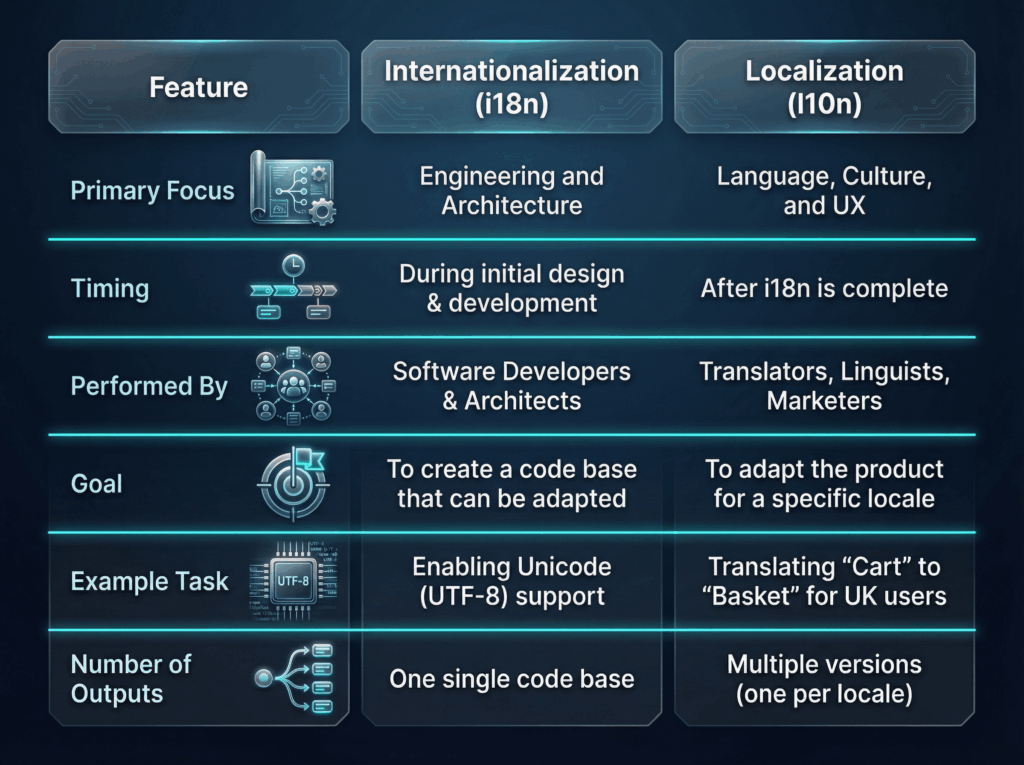
| Feature | Internationalization (i18n) | Localization (l10n) |
| Primary Focus | Engineering and Architecture | Language, Culture, and UX |
| Timing | During initial design & development | After i18n is complete |
| Performed By | Software Developers & Architects | Translators, Linguists, Marketers |
| Goal | To create a code base that can be adapted | To adapt the product for a specific locale |
| Example Task | Enabling Unicode (UTF-8) support | Translating “Cart” to “Basket” for UK users |
| Number of Outputs | One single code base | Multiple versions (one per locale) |
The relationship is symbiotic. You cannot effectively localize a product that hasn’t been internationalized. Conversely, an internationalized product is useless to a global audience if it hasn’t been localized.
The Workflow: Who Goes First?
A common question we hear at Torjoman is regarding the order of operations. Does one strictly follow the other?
Ideally, internationalization comes first. It is a preventative measure. If you try to localize a product that wasn’t built for it, you will engage in what is known as “refactoring”—going back into the code to fix mistakes, which is incredibly time-consuming and expensive.
However, in modern Agile development, the lines blur slightly.
- Phase 1: Developers build the i18n framework (externalizing strings, setting up date handlers).
- Phase 2: A “pseudo-localization” test is run. This involves generating a fake language version of the app to check for hard-coded strings or UI breaks before real translation begins.
- Phase 3: The files are sent to localization experts for translation and cultural adaptation.
- Phase 4: Continuous localization. As new features are added, the i18n best practices ensure new strings are ready for l10n immediately.
Localization vs Globalization vs Internationalization
You might also encounter the term “Globalization” (g11n). Where does this fit in the localization vs internationalization debate?
Think of globalization as the umbrella. It is the strategic decision to enter world markets. It encompasses:
- Market research: Which countries should we target?
- Legal strategy: Can we operate there?
- Internationalization: Preparing the product.
- Localization: Adapting the product.
Globalization is the “What” and the “Why.” Internationalization and Localization are the “How.”
Why This Matters for Your Bottom Line
Why should a stakeholder care about the distinction between i18n vs l10n? Because misunderstanding them creates a leaky bucket for your budget.
Speed to Market
If your source code is internationalized correctly from day one, launching in a new country is relatively fast. It becomes a matter of extracting the language file, sending it to a partner like Torjoman, and importing the new version. If you skip i18n, every new country launch becomes a development project. You have to fork the code, fix bugs specific to that region, and maintain multiple versions of your software. This “technical debt” slows you down significantly.
User Experience and Trust
Users are savvy. They know when they are an afterthought. If a user in Paris sees a mixture of French and English on your checkout page because some strings were hard-coded, they lose trust. If a user in Cairo sees a layout that is Left-to-Right but with Arabic text, it feels broken.
A fully internationalized and localized product feels native. That feeling of “native” is what drives conversion rates. Studies consistently show that the majority of consumers will not buy a product that isn’t in their native language, and they certainly won’t buy from a site that looks broken.
Visibility and Search Rank
Finally, you cannot convert users who cannot find you. Technical internationalization creates the URL structure and tagging (like hreflang) necessary for multilingual SEO. Without this backbone, search engines get confused about which version of your site to show a user in Berlin versus Boston.
Conversely, localization ensures you are targeting the specific keywords and phrases your local users actually search for, rather than direct translations of English terms. Together, these elements form a robust localization SEO strategy that ensures your global expansion drives real organic traffic.
Common Pitfalls in the Process
Even well-intentioned teams stumble. Here are specific challenges where the battle of localization vs internationalization is often lost.
1. Concatenating Strings
Developers love efficiency. Sometimes, they try to construct sentences by gluing words together in code.
- Code: print(“You have ” + number + ” ” + items)
- Result: “You have 5 items.”
This works in English. It fails miserably in languages with complex grammar rules like Russian or German, where the word order changes based on the number or the case. Internationalization requires using placeholders so the translator can move the variables around to fit the grammar of the specific language.
2. Using Images Containing Text
If your “Buy Now” button is an image file with the words baked into the pixels, you have created a localization nightmare. To translate it, you have to open Photoshop, edit the layer, and save a new image for every single language. Internationalization involves using CSS and live text overlay on buttons, so the text can be swapped dynamically.
3. Ignoring “Locale” Specifics
Language is not the same as locale. A user might speak English but live in the UK. If you serve them in the US version (en-US) instead of the UK version (en-GB), you might show them the wrong support phone number or the wrong spelling (Color vs Colour). Effective i18n logic looks at the full locale code (Language_Region) to determine what to show.
Making the Transition Seamless
If you are currently looking at your codebase and realizing it wasn’t built for the world, don’t panic. It is never too late to start the process of adapting products, though it requires a strategic pause.
Start by auditing your code for hard-coded strings. Implement a library (like i18next for JavaScript or gettext for Python) to handle your translations. Once your house is structurally sound, that is when you bring in the interior designers.
This is where Torjoman bridges the gap. We help you navigate the cultural complexities of target markets. Whether you need assistance with the linguistic nuance of your marketing copy or technical guidance on how to structure your resource files for Arabic RTL support, we have the expertise to ensure your transition is smooth.
The World Is Waiting for Your Products and Apps
The debate of localization vs internationalization isn’t really a debate at all. It is a partnership. Internationalization ensures your product functions everywhere. Localization ensures your product connects with everyone.
You cannot build a global legacy on shaky code, and you cannot win local hearts with a generic translation. By respecting the distinct roles of i18n and l10n, you turn your software into a global citizen—flexible, respectful, and ready for business in any language.
Ready to take your product beyond borders? Ensure your foundation is strong and then let us help you speak the language of your customers.
Contact Torjoman today for a consultation on your localization strategy.
FAQs
1.What is the difference between localization and internationalization?
Internationalization (i18n) is the technical process of designing software so it can be adapted to different languages without changing the source code. Localization (l10n) is the process of actually adapting that software for a specific region by translating text, changing formats, and adjusting to cultural norms. Think of i18n as preparing the car for export, and l10n as moving the steering wheel to the right side for the UK market.
2.Why do localization and internationalization matter for global businesses?
They are essential for scalability and revenue. Internationalization removes technical barriers, allowing you to enter new markets faster and cheaper. Localization builds trust and improves user experience (UX), which directly increases conversion rates. Users are unlikely to purchase from a site that doesn’t support their language, currency, or payment methods.
3.Should localization or internationalization come first?
Internationalization should always come first. You must enable your code to support different languages (i18n) before you can actually translate the content (l10n). Trying to localize a product that hasn’t been internationalized usually leads to broken code, display errors, and high costs to fix structural issues.
4.How does localization impact user experience?
Localization makes an application feel native to the user. It ensures that dates, currencies, and numbers are formatted in a way the user understands. It also ensures that cultural references, colors, and images are appropriate and relevant. Good localization reduces friction, making the product easier and more enjoyable to use.
5.What are common challenges in localization vs internationalization?
For internationalization, common challenges include handling text expansion (where translated text is longer than the original), supporting Right-to-Left (RTL) languages like Arabic, and managing character encoding (UTF-8). For localization, challenges include capturing linguistic nuances, avoiding cultural taboos, and maintaining context, so translators don’t mistranslate ambiguous words (like “Home” on a website navigation vs. “Home” in a real estate app).