AI Localization: How Generative AI Transforms Global Content
Global expansion has shifted from a strategic option to a growth mandate. Yet the single greatest barrier to global reach has always been language.
For decades, localization meant long translation cycles, mounting costs, and the constant tension between speed and cultural relevance. That’s changing. Today, AI Localization is rewriting the rules, blending automation, linguistic intelligence, and cultural adaptation to accelerate how brands connect with global audiences.
In this article, we’ll break down the technologies powering this shift, show how companies are deploying AI localization to break down language barriers and accelerate multilingual content, and explore the opportunities and limitations shaping its future.
Table of Contents
A Preface to AI Localization
AI Localization is the integration of artificial intelligence into the translation process to adapt content at scale, in real time, with a level of consistency and speed that human-only systems cannot match. It combines neural machine translation, natural language processing, and increasingly generative AI to automate much of the heavy lifting.
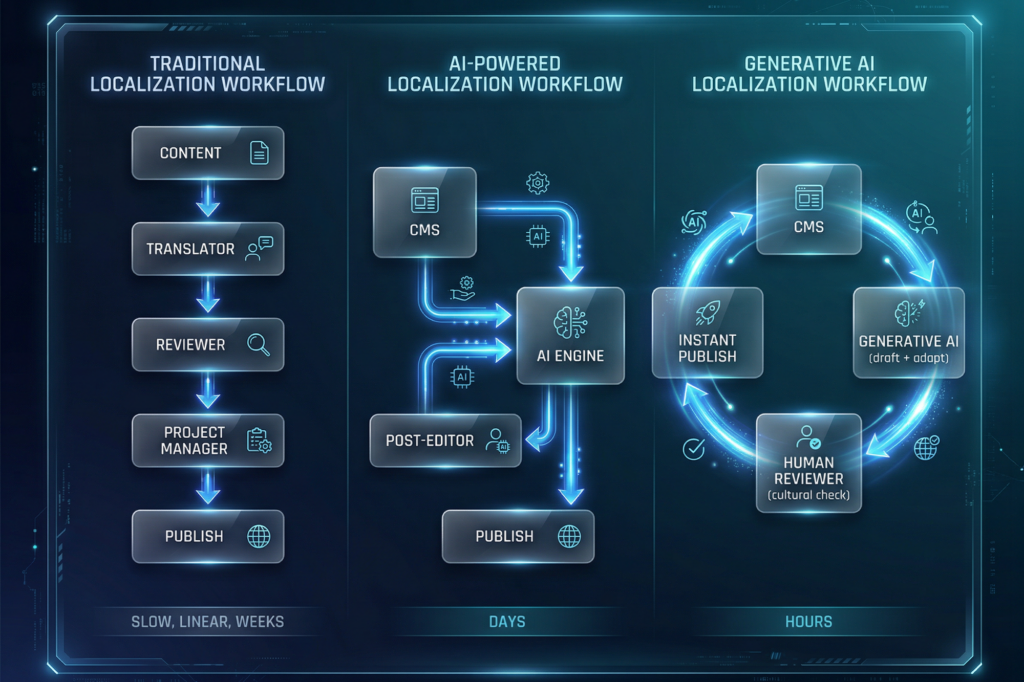
In traditional workflows, a product release in multiple languages involved handoffs between writers, translators, reviewers, and project managers. Content moved through emails, spreadsheets, and disconnected tools. The process was slow, expensive, and often inconsistent. A campaign might launch in English first, with other markets waiting weeks for localized versions. Brand voice varied across regions, and opportunities were lost simply because the infrastructure couldn’t keep up.
With AI-powered localization, these bottlenecks are being dismantled.
Translation engines generate drafts instantly. AI translation tools enforce terminology and style rules across entire projects. Workflows connect directly to content management systems, enabling thousands of words to be localized in hours instead of weeks. Businesses no longer need to choose between speed and quality — AI provides both, with humans focusing their attention on cultural nuance and high-stakes content.
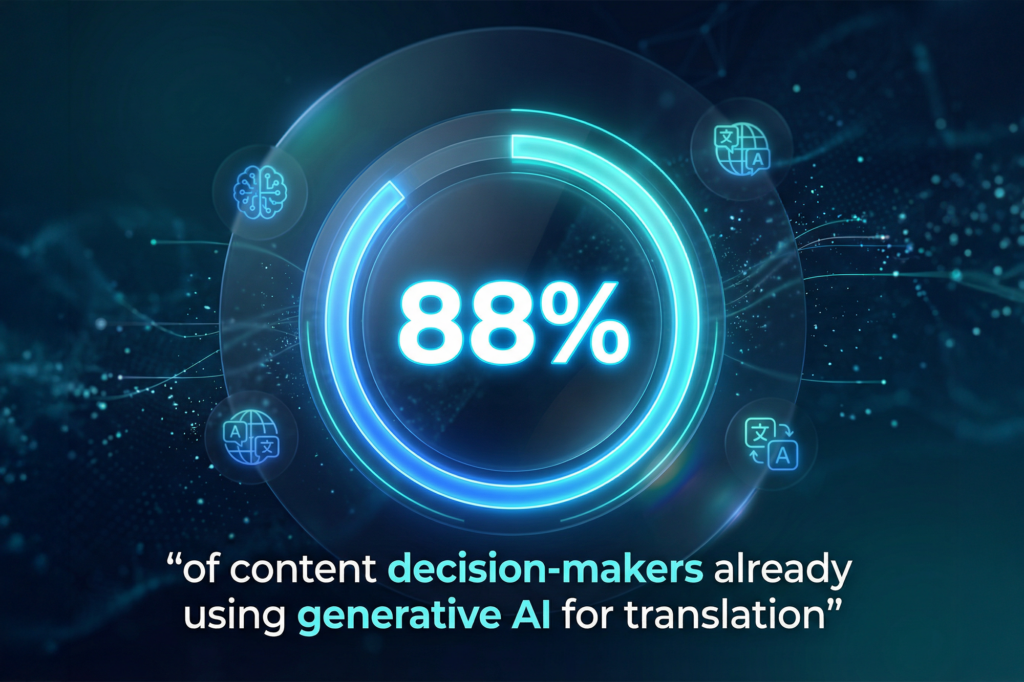
Adoption of AI in translation and localization has moved from institutional to mainstream. In fact, 88% of content decision-makers report using generative AI for translations. What once sat on the margins as a tool for efficiency has become central to how organizations scale multilingual content.
Key Technologies Powering AI Localization
At its core, AI Localization is powered by an ecosystem of interlocking AI technologies, each designed to remove friction from the localization workflow.
1.Neural Machine Translation (NMT)
At the core lies neural machine translation and localization (NMT).
Unlike the rule-based engines of the past, NMT uses deep neural networks that learn from vast bilingual corpora to analyze context, tone, and syntax, producing translations that feel far more natural.
Businesses now deploy NMT models trained on billions of bilingual sentence pairs, enabling them to adapt product manuals, interfaces, and marketing content with a fluency that was impossible a decade ago.
2.Generative AI
Layered on top is generative AI — large language models that don’t just translate, but generate. What once required a copywriter and translator in every market now starts with a single AI-powered workflow.
Think of a system that can rephrase an email into formal German, casual Brazilian Portuguese, or persuasive Japanese marketing copy, depending on the audience. These models can mimic tone, adjust for cultural nuance, and generate localized slogans or ad copy from scratch.
This capability matters because it addresses not only accuracy but also resonance, ensuring that localized content speaks in a voice aligned with both brand and culture.
3.Natural Language Processing (NLP)
Behind these advances sits natural language processing localization (NLP).
NLP enables AI to identify terminology, extract key phrases, detect grammar issues, and apply domain-specific rules. When integrated with translation memory, it ensures consistency across projects by reusing approved phrases and terms. This reduces redundancy and helps maintain a unified brand voice across large-scale multilingual projects.
4.Multilingual AI Systems
Finally, the most exciting progress comes from multilingual AI systems.
Instead of training one model per language pair, these systems handle dozens of languages within a single framework. Through machine learning localization methods, they can even perform zero-shot translation — generating accurate output for language pairs they were never explicitly trained on. This expands reach to low-resource languages and enables businesses to extend their localization strategy into emerging markets more quickly and cost effectively.
The technology stack is no longer static. It’s adaptive, self-learning, and built to scale. AI localization is about creating a digital infrastructure where machines do the heavy lifting and humans refine the nuance.
| Term | Definition | Scope | Key Difference |
| Machine Translation (MT) | Automated translation of text from one language to another using rule-based, statistical, or neural methods. | Narrow — focused only on translation. | Outputs translations, but traditionally limited in context, style, and nuance. |
| Generative AI & LLMs | Outputs translations, but traditionally limited in context, style, and nuance. | Broad — can create, adapt, and rewrite text, not just translate. | More creative and adaptive; can adjust tone, style, and produce multiple localized variations. |
| Machine Learning (ML) | A branch of AI where systems learn patterns from data to improve predictions or tasks over time. | Foundational — supports MT, LLMs, and other AI applications. | Core method behind both MT and generative AI; not specific to translation. |
| AI Translation | Umbrella term for translation powered by any AI technique (MT, NMT, or generative AI). | Broad — covers all AI-based translation approaches. | Includes both traditional MT engines and newer generative AI models. |
Key Advantages of AI-Powered Localization
For businesses under pressure to scale globally, AI localization is a direct path to efficiency.
1.Scalability and Speed to Market
For enterprises, the appeal of AI localization lies in its ability to compress timelines, cut costs, and expand global reach simultaneously.
Traditional localization cycles — four to six weeks to prepare a product launch in multiple languages — simply don’t align with the realities of global competition. AI localization changes the tempo. Translation timelines that once dragged are now compressed into days, sometimes hours.
The real advantage lies in scalability. Global content demand is exploding — product updates, customer support articles, user interfaces, marketing campaigns. With AI, companies are now localizing content in parallel across dozens of markets. No market has to wait. Every audience receives updates in real time, improving fairness and user satisfaction. That kind of synchronization builds brand credibility.
2.Cost-effective Expansion
The financial equation is equally compelling. Companies adopting AI localization report cost savings of up to 60% compared to traditional processes.

3.Quality Assurance and User Experience
But speed and cost aren’t the whole story. There’s also the matter of consistency and quality maintenance.
AI systems apply the same terminology and style guidelines across massive projects, reducing the human variability that often fragments brand voice. When integrated with AI translation tools and translation memory, the output becomes even more stable. And accordingly, a global customer base that experiences a coherent brand personality, regardless of language.
And at the heart of it all lies the user experience. Companies adopting AI localization not only scale faster but also strengthen long-term relationships with their customers. Customers interacting with global content in their own language are more likely to trust the product, engage longer, and return. Research shows higher satisfaction and retention rates when users receive content that feels native.
Top Trends and Innovations in AI Localization
The field isn’t standing still. Emerging trends signal where AI localization is heading, and they carry profound implications for business strategy.
Real-time Localization
One of the most anticipated is real-time localization.
Imagine live video conferences where participants speak in their own languages while AI translates on the fly. Or e-commerce platforms where product reviews instantly appear in the shopper’s preferred language. While still imperfect and lags behind preprocessed translation, these technologies are rapidly improving, bringing global interactivity into the moment.
AI Applications Localization
Chatbots, voice assistants, and SaaS platforms increasingly serve as customer-facing interfaces, and their effectiveness depends on whether they can interact naturally across languages and cultural contexts. A virtual assistant that works smoothly in English but fails to interpret Arabic idioms or Mandarin politeness markers won’t build trust with users in those markets.
This evolution expands the scope of localization, ensuring that AI applications — from fintech apps to healthcare platforms — can communicate seamlessly with global audiences.
AI-driven Quality Control
Equally important is AI-driven quality control. Translation used to rely on spot-checks and human proofreading. Now, AI can automatically flag segments likely to contain errors, score machine output, and highlight inconsistencies across large projects. Some systems even predict the level of human editing required, enabling managers to prioritize resources efficiently.
Quality control is no longer reactive. It’s predictive, proactive, and embedded directly in the workflow.
AI-driven Content Adaptation
The growth of AI-driven content adaptation is another area of innovation.
AI systems can now detect text within images and videos, localize it, and adapt (even regenerate) visual elements for cultural appropriateness. They adjust UI layouts to accommodate text expansion in languages like German, or contraction in Chinese. Symbols, colors, or images that might carry different cultural meanings are flagged and substituted. The result is a more complete adaptation of the overall user experience, visual and functional , not just the words on the screen.
Cultural Relevance and Personalization
While AI and technology are pushing localization toward automation and scale, there’s a counter-movement that stresses the need for hyper-personalization, cultural adaptation, and local-first experiences.
Businesses are learning that speed and volume alone don’t guarantee impact — content must feel authentic to the people consuming it.
Generative AI systems can produce multiple variations of marketing copy, each tailored to local idioms or humor. They analyze local user behavior and recommend language that resonates. This isn’t a generic translation. It’s contextual adaptation at scale. The risk of cultural misstep shrinks, while the chance of resonance grows. Businesses that master this trend will not only speak the language, they’ll speak the culture.
Generative AI Localization
The entry of generative AI into localization has redefined what is possible. Traditional machine translation was designed to convert words across languages; generative AI creates content that adapts to context, tone, and even cultural nuance. This is why its adoption has surged: it doesn’t simply speed up translation, it expands what translation can be.
There are two key roles that GenAI plays in localization:
- Improving Machine Translation
If NMT is the engine, generative AI localization is the accelerator. It’s where the conversation shifts from translation to creation.
Generative AI models — think GPT-based systems — can be prompted to generate entire paragraphs of localized content, adapting style, mood, and register. Translation Management Systems already integrate generative AI assistants into their workflows, enabling linguists to request alternative phrasings or tone adjustments on demand.
This means localization no longer outputs “one best guess” — it produces multiple viable drafts, giving teams creative flexibility while maintaining speed.
- Powering Content Creation for Localization
Instead of waiting for global campaigns to be translated, marketing teams can use AI to draft region-specific social media posts, campaign slogans, or email subject lines. The AI doesn’t just output literal equivalents; it proposes culturally attuned variations that reflect local idioms, humor, or consumer behavior.
For example, an English tagline might generate a playful version for Spanish-speaking millennials, a more formal alternative for German business professionals, and a regionally distinct phrasing for Latin American audiences. The creative ceiling expands dramatically.
Tools and platforms are moving fast. Consumer tech giants are in the race: Amazon’s Alexa supports multilingual interactions through AI, while Meta’s models can translate across 200+ languages simultaneously.
The Human-in-the-Loop: Evolving Role of Translators
One question lingers in every discussion: will AI replace human translators? The reality is more complex. AI is changing the role, not erasing it.
- From Translator to Post-Editors and Quality Controllers. In AI-assisted workflows, routine translation of large text volumes is increasingly automated. This frees human linguists to step into the role of post-editors and reviewers. Instead of spending hours producing literal drafts, their job is less about raw translation and more about refining, ensuring cultural nuance, and capturing intent, nuance, and emotion in ways machines cannot.
- Hybrid Workflow Collaboration. The workflows are increasingly hybrid. AI does the draft. Humans do the refinement. AI enforces consistency. Humans enforce empathy.
In many organizations, this has led to the rise of new roles: linguists specializing in machine translation post-editing and human-in-the-loop systems where machines and people complement each other.
Human experts then review flagged AI outputs and guide your localization strategy by customizing AI systems with domain-specific data. Many professionals are upskilling to manage these workflows, positioning themselves as strategists in the AI era rather than passive users.
Future Outlook: Where AI Localization Is Heading
The trajectory is clear. AI localization is moving toward deeper integration, greater autonomy, and more personalization.
Expect predictive project management — systems that not only translate but anticipate localization needs based on content pipelines. Think self-driving localization workflows where AI monitors CMS activity, localizes drafts, assigns human review automatically, and pushes content live across dozens of languages without manual coordination.
Generative AI will only get smarter. Domain-trained models will understand not just language but industry context, producing more accurate legal translations, medical documents, or technical manuals. Multilingual AI systems will cover low-resource languages with higher accuracy, closing the gap for regions historically underserved by technology.
But the balance will remain. AI will redefine localization, but human translators won’t disappear. They will move further up the value chain — shaping strategy, ensuring cultural sensitivity, and serving as the human conscience in AI-driven systems.
The future isn’t man versus machine. It’s man with machine. Not AI alone, but AI with intent. AI with oversight. AI with a mandate to serve both business goals and human connection.
The Final Verdict
AI localization is no longer experimental. It is the infrastructure of global growth. It delivers cost savings, scalability, and speed, but more importantly, it ensures global audiences feel seen and heard. Companies adopting AI localization today are not only accelerating their expansion but also building stronger relationships with users who experience content in their own language, with cultural relevance intact.
The takeaway is simple: AI does the volume, humans do the nuance. Together, they create a localization strategy that is both cost effective and strategically powerful. Businesses that act now will not just keep pace with globalization — they will set the pace.
If your organization is ready to move from theory to execution, it’s time to explore Torjoman localization services that combine AI agility with human expertise. Because the future of global business won’t wait — and neither should your content.
FAQs
- What is AI localization?
AI localization is the use of artificial intelligence to translate and adapt content for different languages and cultures. It goes beyond word-for-word translation by combining machine learning, neural machine translation, and generative AI to ensure speed, scale, and cultural relevance.
- Why is AI localization important?
Because global growth depends on communication. AI localization enables companies to launch products faster, cut costs by up to 60%, and engage customers with content that feels native — turning localization from a bottleneck into a growth driver.
- What technologies are used in AI localization?
Key technologies include neural machine translation, natural language processing, translation memory systems, and generative AI/LLMs. Together, these technologies automate large volumes of work while allowing humans to focus on nuance, tone, and cultural adaptation.
- What are examples of AI localization?
Real-world cases include enterprises using AI to localize thousands of web pages into multiple languages within hours, SaaS companies rolling out global product updates simultaneously, and marketing teams generating region-specific slogans or ad copy with generative AI — all workflows that were impossible at this speed with human-only processes.